I wanted to check a simple question: are DINs going down and NPNs going up? The published numbers didn’t help. I found figures from 43,000 to 150,000 natural health products, depending on who was counting and when.
So I downloaded both of Health Canada’s databases on 20 October 2026 and counted the records myself. This is what they say.
What I counted
The Licensed Natural Health Products Database (LNHPD) lists every product licence: the NPN, or the DIN-HM for homeopathic products. It has a licence date and a status for each one.
The Drug Product Database (DPD) lists every DIN with its schedule (prescription or non-prescription) and its full status history: marketed, dormant, cancelled.
For DINs I used only human, non-prescription products, and the first date each one was marketed. For NPNs I used the licence date. The method is at the end, so anyone can repeat it.
About 9,000 new NPNs a year, about 100 new non-prescription DINs
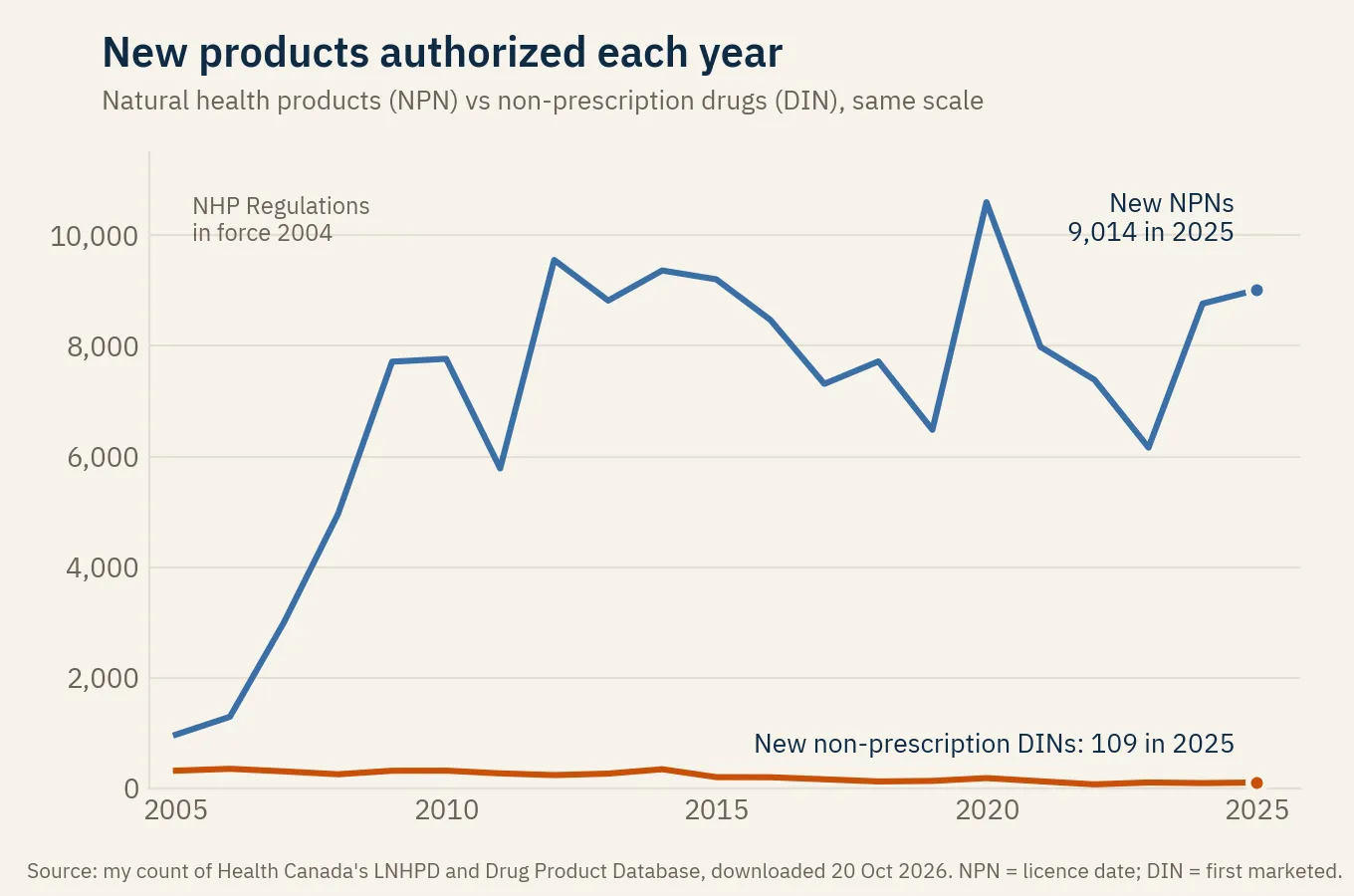
On one scale, the DIN line nearly disappears. In 2025 Health Canada issued 9,014 new NPNs. In the same year, 109 new non-prescription DINs were first marketed.
The NPN numbers have stayed between about 5,800 and 10,600 a year since 2009. The peak was 2020, with 10,599. It is a steady flow. I don’t see a boom.
The DIN number has fallen. It was about 320 a year in the late 2000s and around 100 a year since 2022.
Non-prescription DINs on the books: 5,816 down to 2,038
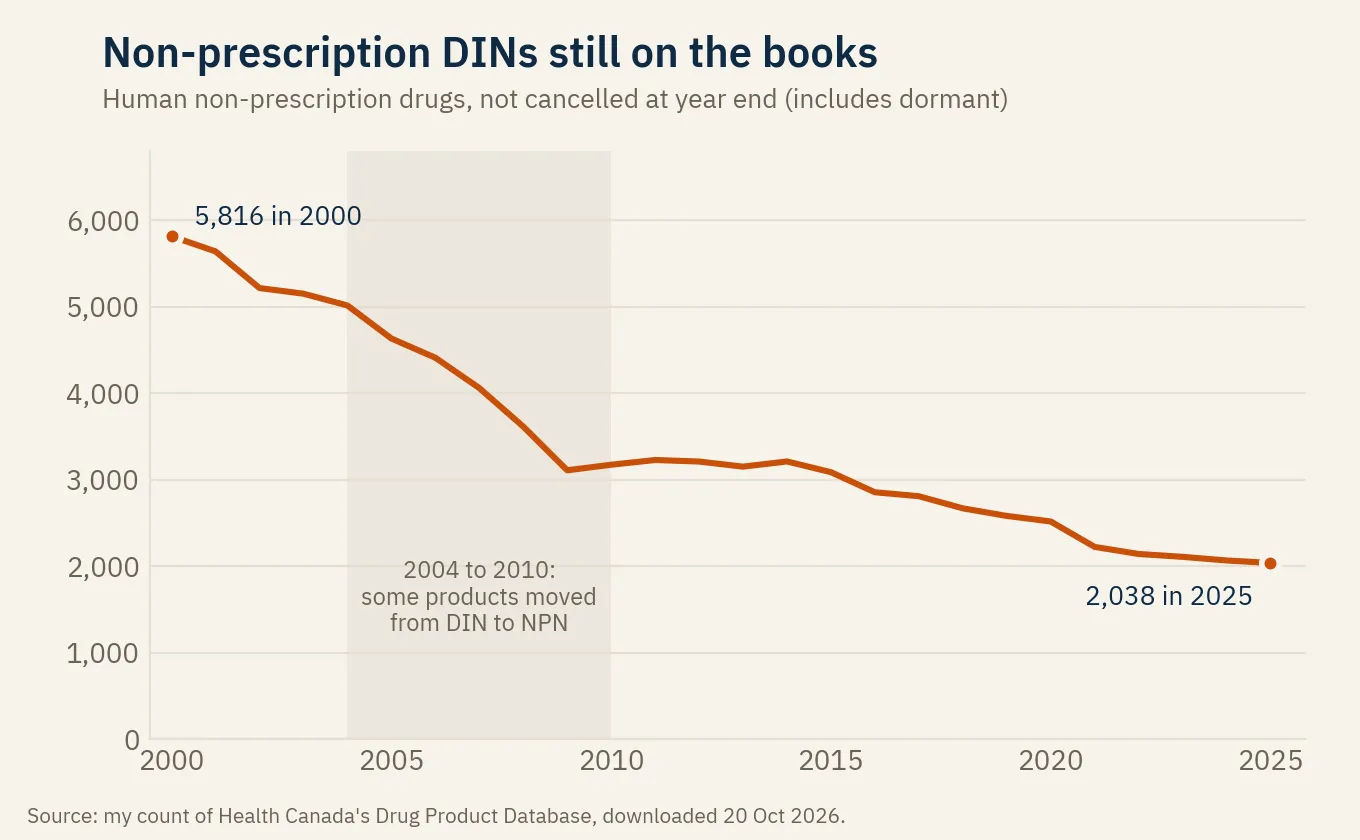
Part of this fall is a reclassification. When the Natural Health Products Regulations came into force in 2004, some products that carried a DIN moved to the NPN system. The LNHPD still labels 3,380 licences as “Transitional DIN”, and about 2,550 of them are active today. That explains much of the steep drop between 2004 and 2010.
But the decline continued after 2010, from about 3,200 to about 2,000. And it is only the non-prescription side. Prescription DINs are not falling: about 440 to 520 new ones a year since 2021.
Who holds the NPNs
In October 2026 the LNHPD held 153,579 licences, and 128,898 were flagged active.
They belong to 9,781 companies. 7,247 of those companies hold five or fewer licences. Every year 300 to 400 companies get their first NPN: 367 in 2023, 324 in 2024, 404 in 2025.
So most NPN holders are small. Many are new brands, importers and private labels.
Most new applications are also the shorter kind. Since 2024, about 12,300 new licences were “Compendial”, which means based on Health Canada monographs. About 6,800 were general applications that needed their own evidence. Health Canada’s service standard is 60 days for a Class I (single monograph) application, 90 for Class II and 210 for Class III.
2026 is slower
From January to September 2026, Health Canada issued 4,755 new NPNs. In the same months of 2025 it was 6,925. That is a drop of about 31%.
Fees did not cause it, because there are none. Health Canada’s proposed NHP fees were postponed and did not start in December 2025.
One possible reason is a policy change. Health Canada’s current Management of Applications Policy, in force since 15 December 2025, says it accepts product licence applications only for products “intended to be sold or manufactured in Canada within 12 months of receiving authorization”. It also says you don’t need a product licence if you don’t plan to sell or manufacture the product in Canada. A February 2026 Health Canada presentation describes the updated forms as a way to remove unnecessary applications.
Health Canada has not linked this rule to the drop, and I can’t see from the database which applications it stopped. So I would call it a likely reason, not a proven one.
What a licence count does not tell you
A licence is not a product on the shelf. An NPN can stay active for years with nothing sold under it. The DIN records track whether each product is marketed, dormant or cancelled, and 13,796 non-prescription DINs have been cancelled after marketing. So the NPN count makes the market look bigger than it is, and the DIN count is closer to what is sold.
I also counted dormant DINs as “on the books”, so if anything the DIN numbers are slightly high.
What this means for testing
An NPN tells you that Health Canada reviewed an application. It says nothing about a specific lot.
And the review is getting lighter. Since 15 June 2026, finished product specifications are no longer submitted with Class II and III applications, and a change to the specifications alone no longer has to be reported. The company keeps them and Health Canada can ask for them at any time. Health Canada has also proposed a simple registration route for products that fully follow a monograph, with no review before the product goes on sale. The formal consultation is planned for spring 2027.
For a product with 9,000 new siblings a year and less review before sale, the lot results and the specifications behind them become the main evidence that the product is what the label says. I wrote about the specifications change in Finished product specifications no longer go to Health Canada.
Sources
Data, downloaded 20 October 2026:
- Health Canada, Licensed Natural Health Products Database, full licence list from its public API (153,579 licences).
- Health Canada, Drug Product Database data extracts: marketed, approved, dormant and inactive files, dated 5 October 2026.
Rules and context:
- Health Canada, Natural Health Products Management of Applications Policy, issued and implemented 15 December 2025 (classes, service standards, and the 12-month eligibility rule).
- Health Canada, Revisions to proposed fees for natural health products (page dated 24 November 2025; implementation postponed).
- Health Canada and PHAC, Report on red tape reduction, 8 September 2025.
- Health Canada NNHPD, “Engagement on Red Tape Reduction Initiatives for Natural Health Products”, stakeholder meeting slides, 10 February 2026.
- Health Canada, Natural Health Product Licensing Bulletin No. 11: Expectations for finished product specifications, 15 June 2026.
How I counted: a DIN is “non-prescription” if every schedule on it is non-prescription or OTC and none is prescription. “On the books” means first marketed by the end of that year and not cancelled by then. An NPN counts in the year of its licence date. Status flag 1 is treated as active. Company counts use the company ID, which includes foreign companies.
Common questions
- How many natural health products are licensed in Canada?
- Health Canada's Licensed Natural Health Products Database held 153,579 product licences in October 2026, of which 128,898 were flagged active. A licence is not the same as a product on the shelf, so the number of products sold is lower.
- Are non-prescription DINs going down in Canada?
- Yes. In the Drug Product Database, human non-prescription DINs not cancelled at year end fell from 5,816 in 2000 to 2,038 in 2025, and new ones first marketed fell from about 580 in 2000 to 109 in 2025. Prescription DINs did not fall: about 440 to 520 new ones a year since 2021.
- Why are there so many more NPNs than DINs?
- Two reasons show in the data. Since the Natural Health Products Regulations came into force in 2004, some products that used to carry a DIN moved to the NPN system (3,380 licences in the database are labelled Transitional DIN). And most NPN applications are monograph-based, which is a shorter route: Health Canada's service standard is 60 days for a Class I application.
- How many companies hold an NPN?
- 9,781 companies in the October 2026 data. 7,247 of them hold five or fewer licences, and 300 to 400 companies get their first NPN each year (404 in 2025).
- Why did new NPNs drop in 2026?
- From January to September 2026, 4,755 new licences were issued, against 6,925 in the same months of 2025. Health Canada has not explained it. A likely reason: since 15 December 2025, Health Canada accepts product licence applications only for products intended to be sold or manufactured in Canada within 12 months of authorization (Natural Health Products Management of Applications Policy).