I once worked on cyanobacterial toxins in water and fish samples. The instrument was a high resolution QTOF. Accurate mass, full scan, the kind of data you want when you do not know what you are looking at.
The job was not identification. The job was quantification, at low concentration, for compounds we already knew by name.
The QTOF could not get there. Not because it was a bad instrument. Because sensitivity for trace quantitation is not what a QTOF is built to give you.
Two different questions
High resolution answers “what is this.” The instrument measures mass accurately enough that you can work out the elemental composition, separate two compounds that differ by a fraction of a mass unit, and go back to old data later to look for something you did not know to look for at the time. For screening and identification it is the right tool and nothing else comes close.
Trace quantitation asks a different question. You already know the compound. You already know its mass. What you need is to see a small amount of it on top of a messy background, reliably, at the bottom of your calibration range.
A triple quadrupole does that by throwing almost everything away. The first quadrupole passes only your precursor mass. The collision cell fragments it. The third quadrupole passes only one chosen fragment. Everything that is not that specific transition is rejected twice before it reaches the detector. The noise disappears and the small signal survives.
A QTOF collects across the whole mass range. That is exactly what makes it useful for screening, and it is also why the sensitivity for one target is lower. The duty cycle is spread across everything instead of concentrated on the few transitions you actually care about.
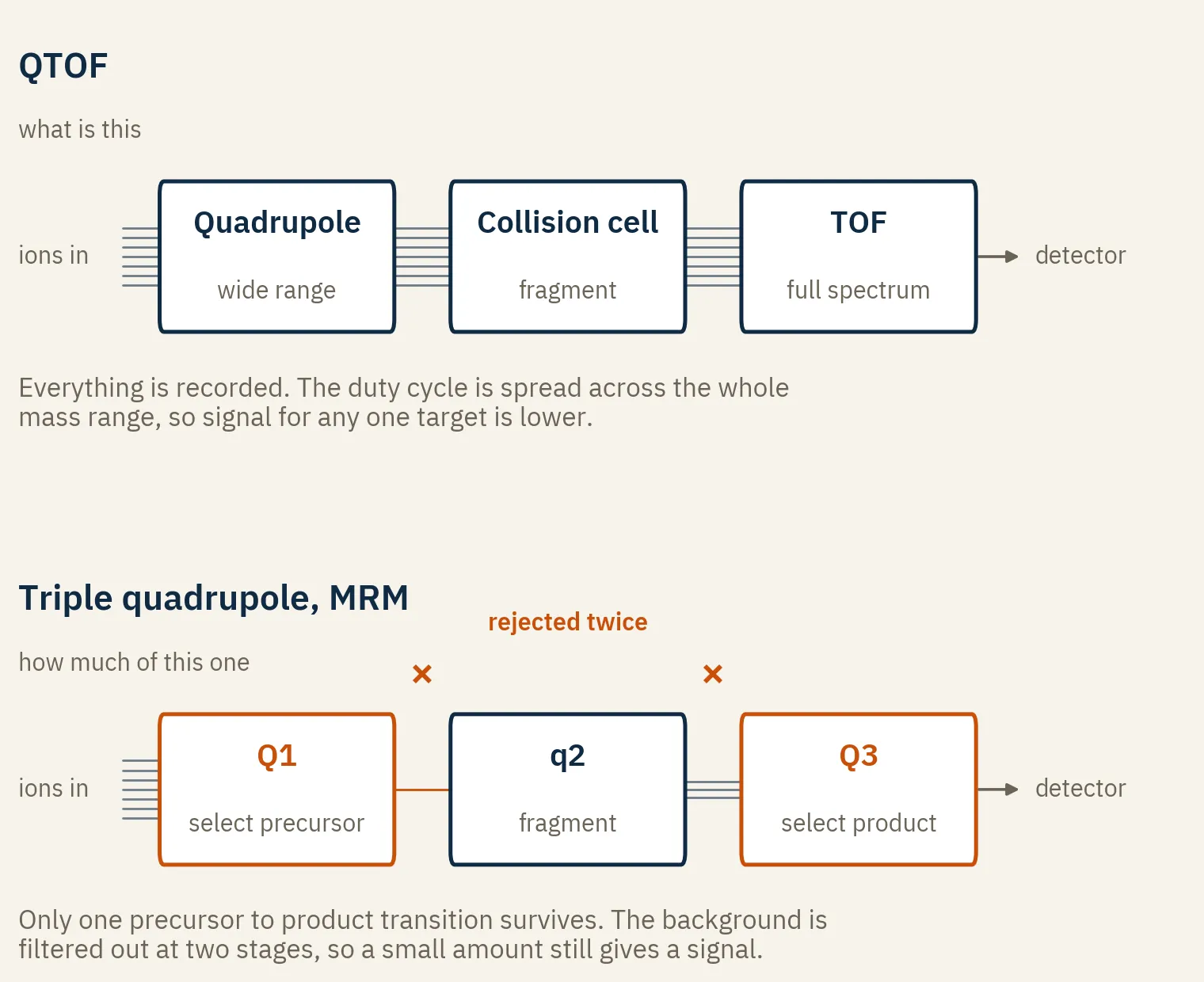
Resolution and sensitivity are separate axes. You can have a very high resolution instrument that still cannot quantify your compound at the level the work requires.
What we did about it
We did not buy a triple quadrupole. There was no budget for one. So we worked inside the limit we had.
That is the ordinary case in most labs. Capital budgets are slow and the sample is in front of you now. So it is worth being clear about the levers that actually exist when the instrument cannot be replaced.
You can put more sample on. A larger starting volume, or solid phase extraction to concentrate the extract, moves the analyte up relative to the detection limit. This is usually the biggest lever and it costs prep time rather than money.
You can reduce the final extract volume. Same idea from the other direction.
You can sharpen the chromatography. A narrower peak is a taller peak at the same amount on column, and peak height is what your signal to noise is measured against. Method development effort converts directly into sensitivity here.
You can narrow what the instrument is doing. Acquiring over a smaller mass range, or running targeted MS/MS rather than full scan, gives back some of the duty cycle you were spending on masses you do not care about.
And you can accept a higher reporting limit, and say so.
The part that matters for the quality system
That last one is not a failure. It is the honest answer, and it is the one an auditor will respect.
If your limit of quantitation sits above the concentration the work needs, the number you report below that limit is not defensible. Reporting it anyway, because the software printed something, is how a lab gets into trouble. The correct move is to state the limit you can actually support and let the person who needs the lower number decide what to do with that.
Sometimes that means the low level samples go to a lab that has the right instrument. Sometimes it means the question changes. Both are better than a number nobody can stand behind.
Deciding before you start
The mistake is easy to make because it does not look like a mistake. The instrument in the room is expensive and modern and the specification sheet is impressive. It is reasonable to assume it will handle whatever comes.
So the question to ask at the start of a method, before any development time goes in, is which of the two jobs you are doing.
If you are looking for compounds you cannot name, or you want to be able to re-interrogate the data in a year, high resolution earns its place.
If you are quantifying a known list at trace level against a regulatory or guideline number, a triple quadrupole running MRM is the tool, and the earlier you know that the better. Finding out during validation costs far more than finding out during scoping.
And if the right instrument is not available and will not be bought, that is a real constraint worth naming out loud at the start of the project, not at the end.
Questions about any of this? You can reach me at [email protected] or on LinkedIn.